

Dishonest scales and false weights
If they are detestable to the Lord, they should be to us as well.

Living in Virginia, I found myself at the heart of the Great Gerrymandering War of 2025-2026, and it has been a discouraging ordeal. The campaign for the redistricting referendum foreshadowed how contentious this year’s midterm elections will be and brought up serious concerns about the future of our electoral system. My mailbox was flooded with misleading ads from the referendum’s opponents, and my daughter and I enjoyed mocking their hypocritical accusations of unfairness, their misuse of past quotes from referendum supporters taken out of context, and their false assertions of solidarity with Black voters who have historically been disenfranchised, before tossing the flyers into the recycling bin.
Now that we’ve had two consequential court rulings, the U.S. Supreme Court decision in Louisiana v. Callais that essentially neutered the Voting Rights Act of 1965, and the Virginia Supreme Court decision in McDougle v. Scott to invalidate the referendum results despite being the expressed will of the voters, I felt compelled to write about this moment in what has been a tumultuous period in our nation’s history, because writing is part of my deliberative process, and I usually arrive at a point of greater clarity at the end. At the very least, I define the boundaries of my ability to affect things, and I make peace with them. Ultimately, I rest in the faith of God’s omniscience, even when things look bleak, and they often do.
So if we’re going to define a war, we need to start with what the fighting is all about.
We get the term “gerrymandering” from the mockery of a state senate district map signed into law in 1812 by Massachusetts Governor Elbridge Gerry (Gerry is pronounced with a hard “g”).
Gerry was a member of the Democratic-Republican Party, which has evolved and divided over time; however, today’s Democratic Party can trace its lineage back to the party founded by Thomas Jefferson. That party eventually split, with Andrew Jackson’s supporters creating the Democratic Party and the breakaway faction of Jackson opponents becoming the Whig Party, which dissolved in 1854.
Most of the Whig Party’s former members joined the newly formed Republican Party, which still exists today. None of these parties resembles, in terms of ideology or practice, what they were then, so these histories are largely academic in their description of the origins of today’s partisan politics.
Gerry’s party was in control in Massachusetts, and the map he approved was intended to favor them. However, the unique geography of one particular district, the Massachusetts Senate district of South Essex, was mocked by his opponents in the Federalist Party as resembling a salamander. Someone came up with the clever lexical blend of Gerry’s last name and “salamander,” and the Boston Gazette introduced the word “Gerry-mander” to the public for the first time on March 26, 1812.
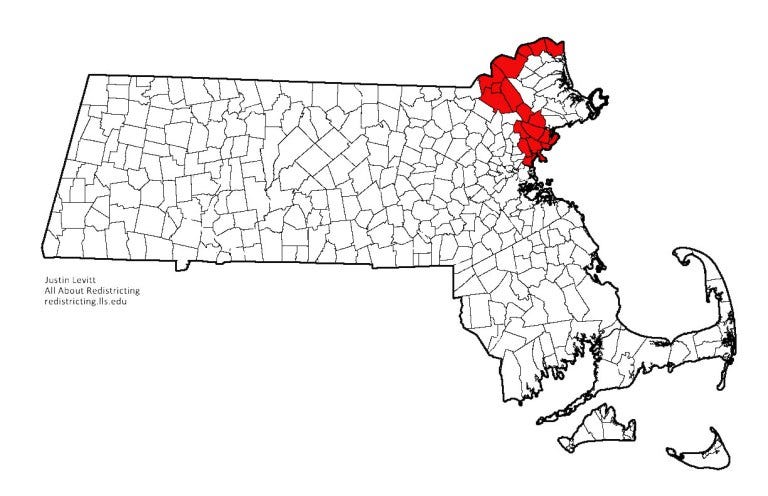
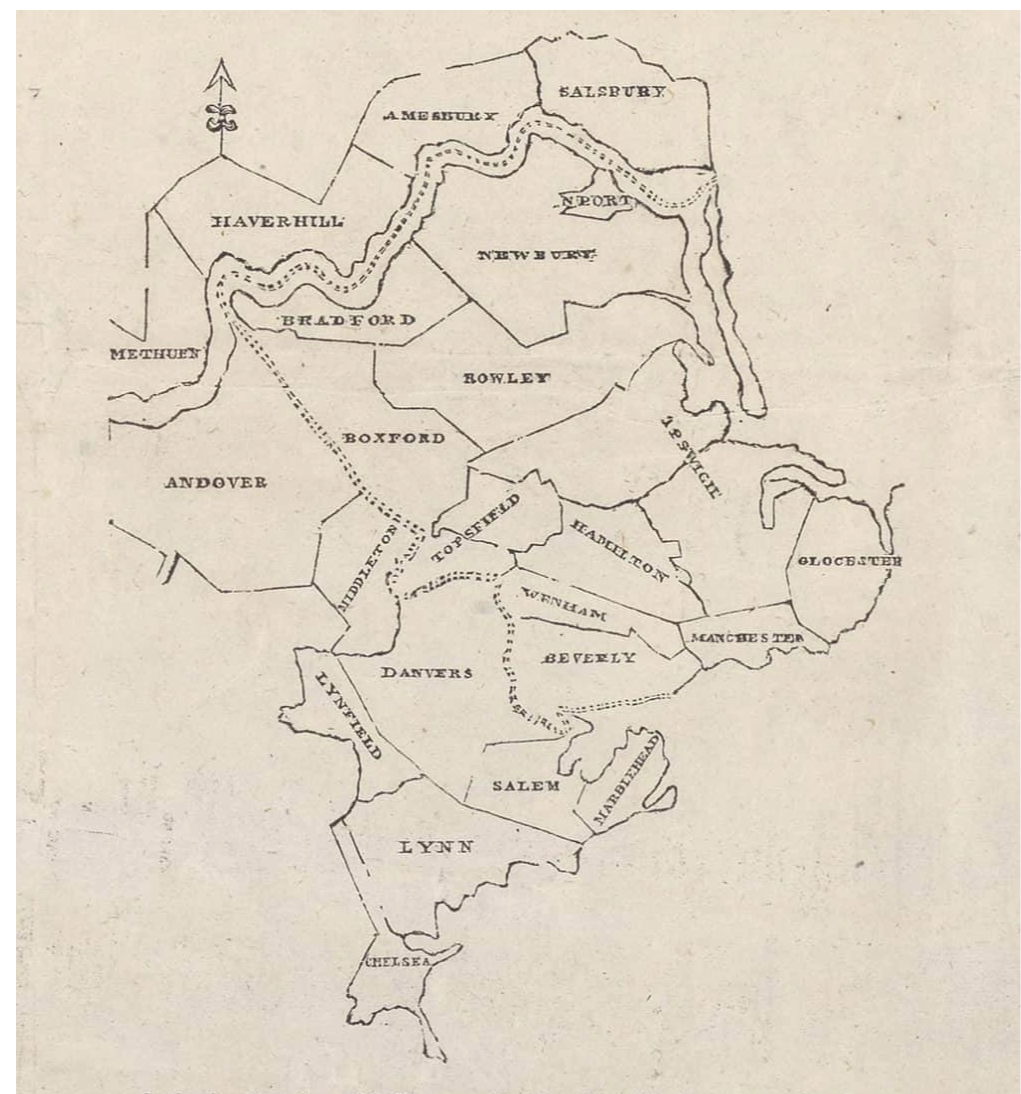
Accompanying the article was an illustration by artist Elkanah Tisdale entitled “The Gerry-Mander”, and it is the most famous depiction of the infamous Massachusetts district. In fact, it was hard for me to find a map of the original district without the artistic embellishments.
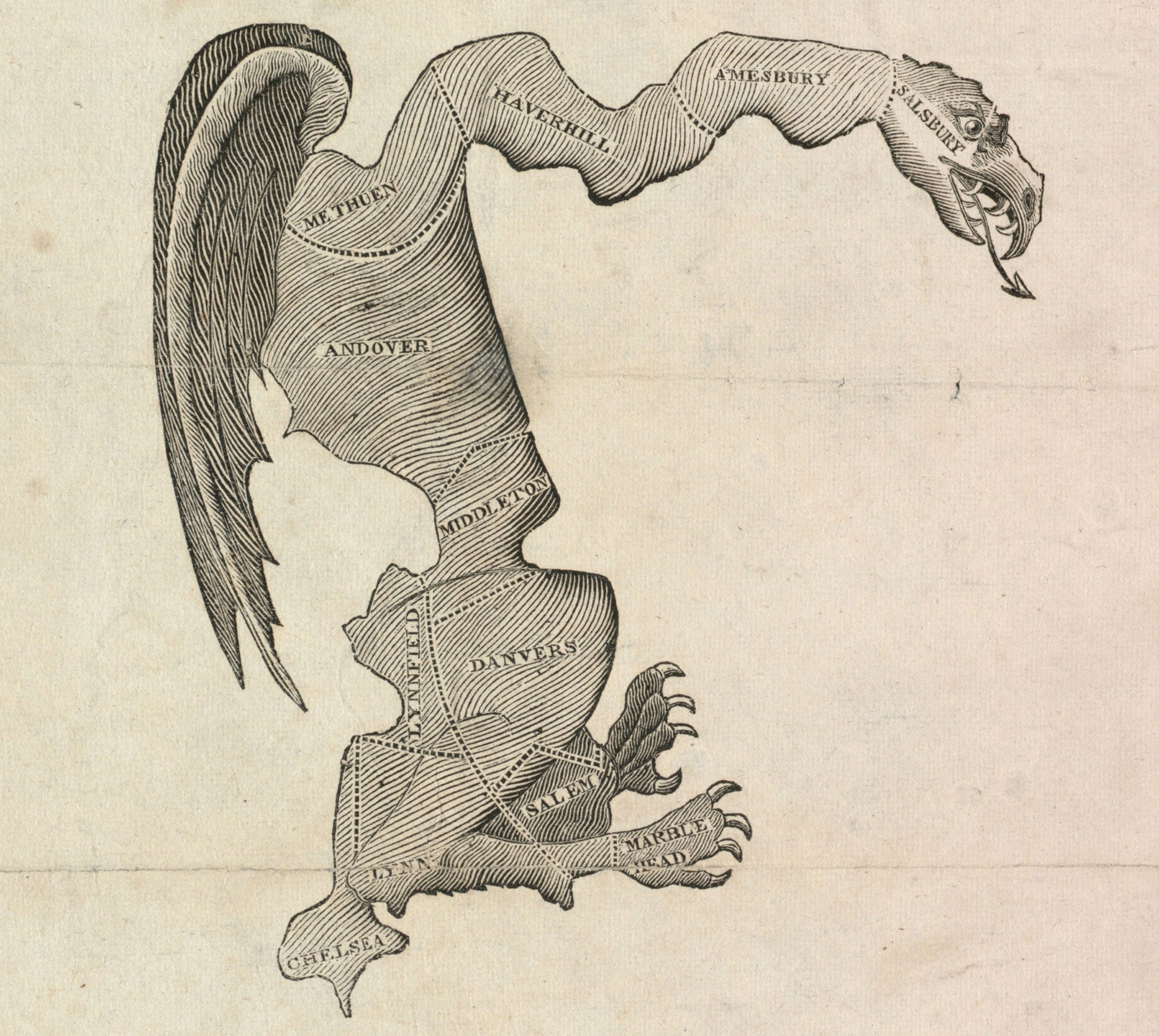
Although Gerry was pronounced with a hard “g,” and so was the new word initially, over time, the soft “g” became more common and is the standard usage today. The torturously designed district had its intended effect; the Democratic-Republicans kept control of the Massachusetts Senate in the 1812 elections, but Governor Gerry and his party went down to defeat, losing the governorship and the Massachusetts House of Representatives. Gerry, a signatory to the Declaration of Independence and the Articles of Confederation, later became the fifth vice president of the United States under James Madison in 1813. He served only 21 months before dying of a heart attack on November 23, 1814, and is the only signer of the Declaration of Independence buried in Washington, D.C.
Article I, Section 4, Clause 1 of the Constitution of the United States says:
The Times, Places and Manner of holding Elections for Senators and Representatives, shall be prescribed in each State by the Legislature thereof; but the Congress may at any time by Law make or alter such Regulations, except as to the Places of chusing (sic) Senators.
Congress has exercised its constitutional authority over elections, according to the Brennan Center for Justice, “to protect voters’ rights to access and cast ballots, set baseline national standards to ensure fairness, and provide funding and services to election officials to help them run elections more effectively.” Otherwise, the states are free to administer elections as they see fit, including redistricting.
Typically, Congressional redistricting is a state-level responsibility, with state legislatures, or, in some cases, independent commissions, drawing district boundaries every 10 years following the federal census. States with independent commissions for that purpose are attempting to remove partisanship from the process, but in states where the legislature draws the districts, the political party controlling the state government usually designs the maps in its favor.
This is nakedly partisan and, until recently, was viewed unfavorably by most Americans. A NORC survey reveals that, “When it comes to drawing legislative district boundaries, Americans overwhelmingly favor taking politics out of the process.”
Avoiding partisan favoritism ranks as the top priority, followed closely by using neutral, transparent rules and keeping communities together. Taken together, the data point to a clear preference for common‑sense standards over political advantage in how maps are drawn.
Despite these findings, partisan redistricting is not illegal if it’s not called out in a state’s constitution or laws, or rendered irrelevant by the establishment of an independent commission. The U.S. Supreme Court’s Rucho v. Common Cause ruling held that partisan redistricting is a political matter and not subject to federal-court review, and efforts in the U.S. Congress to pass a law against it have not succeeded.
There is one form of redistricting that is illegal, and that is racial redistricting to dilute the voting power of racial minorities, forbidden by the Voting Rights Act of 1965.
So, until 2026, it was understood that:
Redistricting is a state responsibility and comes under either the state government or an independent commission granted authority by the state.
It happens only after the federal census.
Partisan redistricting is unpopular with the public, but it’s not illegal and happens often.
Using race as a factor in drawing districts that dilute minority representation is against the law.
Leave it to Donald John Trump, the New York City real estate developer-turned-president of the United States, who seems to have a greater penchant for destruction than construction, to upend every consensus and accepted norm when it comes to redistricting. The irony is that the same man who declares every election he or his party loses to be “rigged” is doing exactly that to try to secure his political party’s razor-thin majority in the U.S. House of Representatives.
The congressional midterm elections, which occur two years after the previous presidential election and two years before the next, are typically not favorable for the party that occupies the White House, and if that party also controls the House and the Senate, as the GOP does, it’s likely that they will lose control of one or both. There are only two times since 1934 that the ruling party has gained seats in the House and Senate during the midterms: the 1934 election itself, when Franklin Delano Roosevelt was president, and 2002, when George W. Bush was president.
While voter turnout is typically low during midterm elections, this one is expected to buck the trend. President Trump has been on an unprecedented rampage over the past 15 months, remaking the federal government to pledge full loyalty to him rather than to the people, deploying the nation’s top law enforcement agency against his perceived enemies, and releasing a masked, paramilitary force onto the streets of American cities to terrorize immigrants, American citizens suspected of being immigrants, and Americans who defend immigrants as fellow image-bearers of God, all the while exploiting the presidency to enrich himself and his family to levels unseen in American history. His military excursions into Iran and Venezuela have even caused rifts among his supporters, Marjorie Taylor Greene and Tucker Carlson prominent among them. Inflation, which he promised to end as soon as he took office, is higher than it was when he took office, and the war in Iran has caused gas prices to skyrocket. The cost of grocery items, such as beef and chicken, remains high, although egg prices have fallen.
The scope and nature of the chaos he has unleashed on the nation reflect two realities, whether he admits them or not.
First, he knows that for the entirety of his term, he may not have a Congress that rolls over and shows its belly whenever he commands it, so he's issuing executive orders, demanding the prosecution of his enemies, attempting to distract us with foreign military excursions he can neither explain nor justify, and unleashing furious rants on social media in the early-morning hours, at a frenetic pace. He is likely concerned, with some justification, that a Democratic Congress will impeach him for the third time.
Second, his disapproval rating is at an all-time high. When you combine that with past midterm trends against the party in power, Republicans have every reason to expect a potentially historic rejection at the polls in November.
As a result, Trump demanded something no one had done in recent memory: he asked the Texas state legislature to create five new winnable congressional seats for the GOP through mid-decade redistricting, rather than waiting until the 2030 census. There was high drama, including the walkout of over 50 Texas Democrats in the legislature, who left the state rather than vote on the proposal. Eventually, they returned, the proposal was passed, and it withstood a Supreme Court challenge; therefore, the first shots of the Great Gerrymandering War of 2025-2026 were fired.
In November 2025, the voters of the state of California approved a redistricting plan that would effectively neutralize the Texas redistricting action by creating five new winnable seats for the Democrats. However, Missouri, North Carolina, Ohio, Florida, and Tennessee have all enacted revised House districts that boost the GOP’s chances of winning nine additional seats in all. A court-ordered map in Utah produced one Democratic gain after a judge imposed it in place of the map lawmakers had previously passed, ruling that the legislature's map violated the state's anti-gerrymandering law.
Louisiana, Alabama, and South Carolina, in the wake of Louisiana v. Callais, are seeking to quickly revise their congressional maps so they can take effect in the 2026 election, adding three seats to the GOP tally.
If you’re keeping score, it’s GOP 17, Democrats 6. Since this “winnable seat” strategy is a zero-sum game, you can subtract the number of winnable seats from each party according to how many their opponents gain.
Then, my home state of Virginia entered the fray, and on April 21st, the voters approved a redistricting plan that would have gained four additional winnable seats for the Democrats. That is the referendum that the Virginia Supreme Court declared invalid on a technicality involving when the Virginia General Assembly voted on it. Any referendum that amends the state constitution, as this one would, must have two votes, with one held before an election so voters know how their representatives voted and can cast their ballots accordingly. The court said that people who participated in early voting for Virginia’s election on November 4th, 2025, which began on September 19th, did not have an opportunity to use their representative’s vote on the referendum to inform their ballots, because that vote took place on October 31st, just days before the election.
Did you get all that?
Therefore, despite the people's expressed will in the April 21st vote, the court ruled against the referendum. The attorney general of Virginia is appealing to the U.S. Supreme Court, despite questions about whether federal jurisdiction applies to matters involving a state constitution. One of his key arguments is that the Virginia Supreme Court misinterpreted the term “election” under federal law.
The Virginia Supreme Court's decision was a serious blow to a party already reeling from the U.S. Supreme Court's decision disallowing a majority-minority district in Louisiana because it represented a "racial gerrymander," which is illegal. However, majority-minority congressional districts in Alabama were upheld on similar grounds by the Supreme Court as recently as 2023 by the very same justices. One wonders what changed so dramatically in just three years that they felt compelled to make a 180-degree turn and essentially render the Voting Rights Act of 1965, one of the greatest accomplishments of the American civil rights movement, impotent.
The Voting Rights Act of 1965 was necessary because of the South’s refusal to honor the 15th Amendment granting Black people the right to vote, and Section 2 of the law begins with this statement.
No voting qualification or prerequisite to voting or standard, practice, or procedure shall be imposed or applied by any State or political subdivision in a manner which results in a denial or abridgment of the right of any citizen of the United States to vote on account of race or color…
This meant, among other things, no more poll taxes, literacy tests, or congressional districts designed to dilute the Black vote and prevent Black voters from electing representatives more attuned to their priorities. The Voting Rights Act helped Black voters exercise their voice, and many Black representatives were elected to ensure those voices were heard in the institutions where laws were made and enforced.
In the past, you didn’t need to prove racial intent to declare a congressional map illegal for racial discrimination. If a redrawn congressional map was discriminatory against Black voters based on the electoral outcome, it was deemed invalid, and the courts compelled the states to redraw it. After Louisiana v. Callais, the burden of proof falls on the litigants to show that race was the reason for redistricting, and proving racial intent is nearly impossible. Moreover, Justice Samuel Alito made an incredible statement, as reflected in this New York Times report.
But Justice Alito argued that “vast social change,” particularly in the South, made such considerations no longer necessary.
Discrimination that occurred years or decades ago, as well as certain “present-day disparities,” are “entitled to much less weight” now, he wrote for the majority.
Many civil rights advocates decried this statement, saying it revealed the justice’s ignorance about the continued disparities in generational wealth, educational outcomes, average income, life expectancy, and infant mortality that exist between Black and white Americans. It is also dismissive of the multigenerational effects of slavery and systemic and institutionalized racism, which people wouldn't understand unless they read the true, unsanitized version of American history. Alito’s uninformed statement certainly opened my eyes to why we are still talking about race in America today. I can assure you it’s a necessary conversation because past discrimination and “present-day disparities” are not inconsequential. But that’s a topic for another time.
However, I want to point out the irony in the states that chose to act on the Supreme Court’s ruling almost immediately after it was published.
Tennessee and Florida passed new maps within a matter of days; Louisiana suspended its primary elections in order to do the same; and Mississippi and Alabama are seeking to call special sessions of their legislatures to consider new maps. In the wake of Louisiana v. Callais, the Supreme Court cleared the path for Alabama to revert to a map with only one majority-Black congressional district, a map that a lower court had disallowed in 2023. The Supreme Court sided with the lower court in its decision back in 2023, but the “vast social change” mentioned in the majority opinion, which none of the people affected by the purported change have actually experienced, prompted them to flip like an Olympic gymnast.
The Voting Rights Act of 1965 contains "special provisions" that apply to jurisdictions with a history of racial discrimination in voting, and the Southern states that have either redistricted or are seeking to redistrict are on the list.
So the irony is this: if you add what’s already been done in Texas and North Carolina, and what Trump is pressuring the South Carolina Senate to do, the grouping of states racing to redraw their maps and eliminate majority-minority districts would look almost like the Confederate States of America, minus three former states.
Arkansas isn’t redistricting because all four of its members of Congress are Republicans, and it hasn’t elected a Democrat to Congress in 14 years. Two of the remaining states, Georgia and Virginia, are probably the only legitimate “purple” states in the old Confederacy. Georgia’s governor, Brian Kemp, a “frenemy” of the president, has resisted calls to redistrict for the 2026 mid-term elections, but is open to doing so before the 2028 presidential elections.
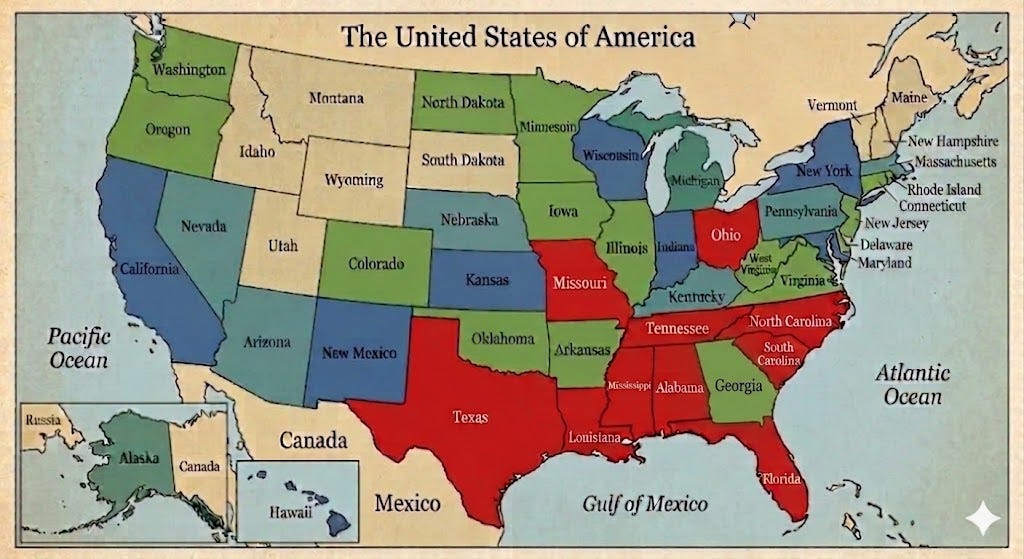
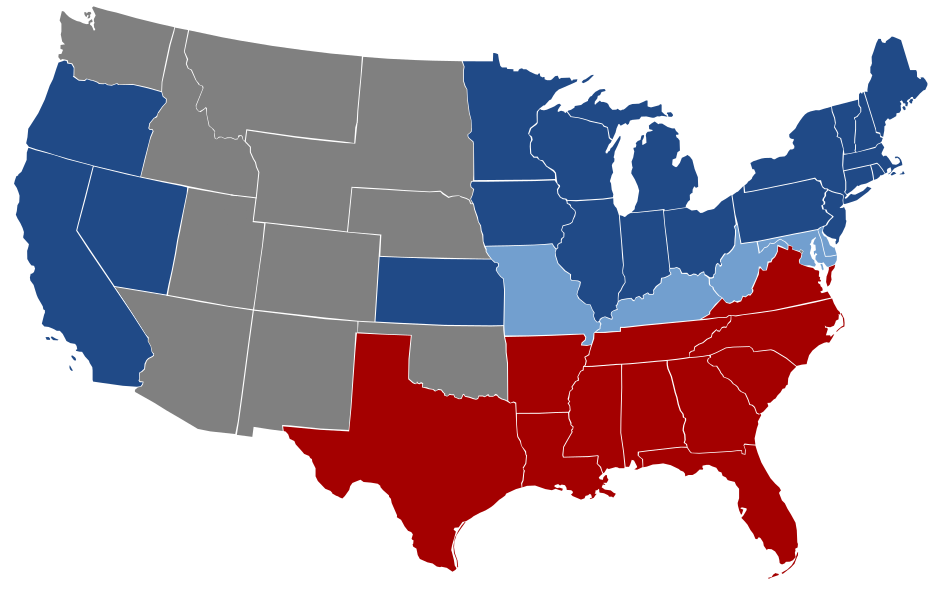
But we’ve had “vast social change” in just three years’ time, according to Justice Alito. Perhaps he needs to venture beyond the confines of the courthouse or his suburban home in northern Virginia, although I doubt that would help.
So, here we are as the 2026 midterm election approaches, and states like New York, Illinois, Washington, and Maryland are having conversations about how to counter this Republican redistricting surge that threatens to remake Congress. What Trump unleashed in Texas threatens to carry over into the 2028 presidential election, so there is no immediate end in sight to the Great Gerrymandering War of 2025-2026. A Wikipedia article calls it “one of the largest coordinated attempts to redraw congressional districts between decennial censuses in modern American history.”
It has also prompted a complex discussion about how Democrats should meet this moment. While some argue that two wrongs don’t make a right and that Democrats shouldn’t stoop to the level of their GOP counterparts, others say the consequences of allowing Republicans to retain control of Congress for another two years, rubber-stamping everything President Trump says or does, could be devastating to our democratic republic, and that this must be prevented by any means necessary.
To me, the question of whether to play by the rules when your opponent eviscerates them is a political and moral one, and there is no simple answer. I am reminded of Dietrich Bonhoeffer, the German theologian executed by the Nazis in 1945 for his involvement in the anti-Nazi resistance, which implicated him in a plot to assassinate Hitler. Although not directly involved, he was likely aware of the plot and didn’t discourage others from carrying it out. Politically, ridding the nation of Hitler was entirely defensible; he was leading Germany to certain defeat in World War II, and the resistance had become aware of the full extent of his atrocities against the Jews and other minorities, and his unspeakable actions justified tyrannicide. However, as a devout Christian, Bonhoeffer took God’s command against murder seriously and didn’t attempt to explain it or absolve himself of the guilt of condoning such an action, even if not at his own hand.
“When a man takes guilt upon himself in responsibility, he imputes his guilt to himself and no one else. He answers for it... Before other men he is justified by dire necessity; before himself he is acquitted by his conscience, but before God he hopes only for grace.” ~ Ethics, Dietrich Bonhoeffer
Fortunately, the decision before the Democrats has nothing to do with violence of any kind. Frankly, I don’t have a good answer for how the Democrats should respond. I understand the political calculus, and their opponents seem hell-bent on rewriting the electoral map as much as possible to their advantage before the next election.
However, in some states, because of reforms they instituted to take partisanship out of redistricting, the Democrats, who, according to a Politico article, are “historically the party aligning itself with 'good-government’ reforms such as opposition to partisan gerrymandering,” have tied their own hands. As a result, they “have made a sharp U-turn on redistricting this year as Trump and Republicans push the bounds of mid-cycle map-drawing.”
The reason Virginia had to go through a convoluted process to get the referendum on the ballot is that the commonwealth is one of the states with an independent commission that draws congressional maps, presumably free of partisan gerrymandering. California has a similar commission, so in both cases, the state governments took the question to the voters to get their permission to bypass the commissions. The popular vote is yet another distinction the Democrats have from the GOP in the Great Gerrymandering War of 2025-2026: at least to date, none of the states that have redistricted in the GOP’s favor have given the people a say in the decision.
One thing I can say with certainty is that the Republicans in my home state who are exulting in the Virginia State Supreme Court’s decision as a “moral” victory can spare me the sanctimony. Not only did they run a deceptive ad campaign and feign concern about the minority vote while cheering on the numerous racially charged actions of the current presidential administration, but they were also either silent or endorsed the redistricting power grabs in Texas and other states where their political counterparts controlled the levers of government.
If you weren’t as vociferously and publicly opposed to gerrymandering in Texas and elsewhere as you were here in Virginia, you have no authority to claim the moral high ground. Frankly, there is none; this is not an occasion for lofty language and high ethics; this is raw, bare-knuckled politics, and people on both sides of the political aisle should stop pretending it’s anything else.
It also takes a ton of chutzpah to claim that the Democrats cheat in elections, one of President Trump’s persistent claims that Republicans love to echo, when they are openly and brazenly reengineering the electoral map to tip the scales in their favor. I don’t want to hear another GOP jeremiad about Democrats rigging elections ever again.
Regrettably, the Great Gerrymandering War of 2025-2026 has also turned public opinion. While, in the past, comfortable majorities of voters, regardless of party, opposed partisan gerrymandering, a poll at the end of last year revealed the intensity of this partisan battle.
A new POLITICO Poll shows both Democrats and Republicans support redrawing congressional districts to give their side a boost in the midterms. And there is no apparent appetite for a ceasefire in the gerrymandering wars: Most voters on the left and right favor using partisan redistricting not just to level the playing field, but as a weapon to help them win.
Some observers hope this is just a temporary response and that the desire for government reform will return in the near future, presumably after this election cycle.
I sought guidance in the Scriptures to help me form my thoughts on this topic, and while popular elections were not how kingdoms rose and fell in Biblical times, there was one form of public interaction that gives us a sense of God’s heart - commerce.
Do not use dishonest standards when measuring length, weight or quantity. Use honest scales and honest weights, an honest ephah and an honest hin. I am the Lord your God, who brought you out of Egypt. (Leviticus 19:35-36)
An “ephah” was a dry measure with a capacity of about 3/5 of a bushel, or about 22 liters, and a “hin” was a liquid measure having the capacity of about 1 gallon or about 3.8 liters. This admonition against dishonest weights and measures is repeated throughout the Old Testament in Deuteronomy 25:13-15; Proverbs 11:1; Proverbs 16:11; Proverbs 20:10; Hosea 12:7; and Micah 6:10-11.
The Lord declares dishonesty in commerce an “abomination” (Proverbs 11:1) and “detestable” (Proverbs 20:10), while honesty is “from the Lord” (Proverbs 16:11) and “His delight” (Proverbs 20:10).
When it comes to redistricting, it seems that the only standard that honors the Lord is one that is fair and honest and doesn’t give the politicians, the “merchants” in this analogy, an advantage over the voters, the “customers.” Fair redistricting keeps communities together, reflects their diversity, and gives every voter an equal voice. The process should be transparent, free from political influence, and encourage voter participation in decision-making. At some point, responsible citizens have to stand up and say “no more,” even if it costs them, as it did several state senators in Indiana.
There is one other thing people can do to launch a counteroffensive in the Great Gerrymandering War of 2025-2026: vote in this year’s mid-term election. Redistricting is not a guarantee of outcome; only your vote will matter in the end.