

Understanding the times
What do you want your successors to say about you after you're gone?

I was an air intelligence officer in the U.S. Air Force for almost 9 1/2 years, and most of that time was spent analyzing and reporting on the Soviet Union and its Warsaw Pact allies. During my assignment to what was then West Germany, as part of a U.S. intelligence detachment in a nuclear-blast-resistant bunker that would serve as one of the North Atlantic Treaty Organization’s (NATO) primary war headquarters, I had the opportunity to learn a great deal about the history of the alliance and how Germany was rehabilitated from its horrific Nazi past to become a trusted ally. Living in Germany for four years gave me the opportunity to become well acquainted with the country and its people, aided by my multilingual bride.
Both Russia and Germany are nations of exceptional beauty, their landscapes and legacies adorned with profound artistry. They have significantly contributed to the world’s collective heritage, leaving an indelible mark on arts, architecture, music, philosophy, education, religion, and other domains of shared human culture.
As I studied these nations and their histories, which, from a military perspective, are stained by the atrocities of Stalinism and Naziism respectively, I often asked myself how nations with such refined civilizations could have allowed such barbarism to take hold of the populace. I would add that the question in my mind would always be followed by an emphatic statement, “That would never happen in America.”
As I think back on that time in my life, I am amused and a little embarrassed at how ignorant and naive I was. Even without the breadth and depth of American history I’ve learned on my own, I was aware of the history of American atrocities against Black people, indigenous Americans, Asian-Americans, and others. However, my thinking at the time was not about what America had done, but what it had overcome. I honestly believed much of the evil that motivated America’s worst behavior had been pushed to the fringes of our collective consciousness and was no longer capable of infecting our society.
Many, if not most of us, have said it as a point of pride and exceptionalism: “It can’t happen here.” However, as I sit here, almost 34 years removed from my last day of duty as an intelligence officer, I have reached the sad conclusion that not only can it happen here, it has happened here before on our soil, it can happen again, and the people who are actively trying to make it happen again are ascendant and emboldened to make it happen again.
My sponsor, mentor, and boss at Liberty University was fond of quoting a passage of Scripture from the Old Testament to illustrate the discernment and wisdom that Christ-followers must possess:
From the sons of Issachar, men who understood the times, with knowledge of what Israel should do, their chiefs were two hundred; and all their kinsmen were at their command. (1 Chronicles 12:32)
Issachar was the ninth son of Jacob, whom the Lord named Israel, meaning “he strived with God,” after he spent a night wrestling with an angel. Issachar was one of Jacob's 12 sons and represented one of the 12 tribes of Israel. The “sons of Issachar,” his descendants, numbered about 87,000 during King David’s reign, and they were known to be intensely loyal to the King, who they correctly discerned was God’s anointed one and therefore worthy of their allegiance.
The verse in 1 Chronicles states that the descendants of Issachar “understood the times, with knowledge of what Israel should do,” suggesting their awareness of the moment they found themselves in and how they were to respond.
I could delve into how this particular passage of Scripture gained popularity within certain Christian circles, particularly among Pentecostal, charismatic, and various non-denominational evangelical traditions, as they often misinterpret it as evidence of a mystical gift of prophecy – the ability to foresee the future – a partisan political agenda, or a special talent bestowed by God upon a select few or an unchallengeable elite leadership group. Suffice to say, I’m not going in that direction.
In the context of the passage, the sons of Issachar realized that David, not Saul, was the anointed king of Israel, and therefore it was their duty to steer the people of Israel toward David as their future leader. This wasn’t mysticism or an exclusive gift, but what we in the military would call “situational awareness” at a strategic level. Once their situational awareness was where it needed to be, they sought and received God’s direction for their nation's future, and they shared that wisdom with others.
Ironically, the sons of Issachar, by exhibiting discernment and having their senses on alert to hear God’s voice, were “woke” in the original definition of the term as it was intended by the Black community before it was co-opted and corrupted into a synonym for anything the current sociopolitical movement doesn’t like. To Black Americans in the first half of the 20th century, when the word “woke” and associated phrases gained traction as defining black political consciousness, it meant being aware of racial injustice and violence in the times in which they lived, being vigilant about the dangers they posed, and acting accordingly to protect themselves and others.
That is an inherently biblical way to live; it’s the very description of Jesus’ admonition to his disciples: “I am sending you out like sheep among wolves. Therefore be as shrewd as snakes and as innocent as doves” (Matthew 10:16).
How many times in the Bible are believers told to be alert, to be on guard, to keep awake, or not to be caught asleep?
“So then, let us not be like others, who are asleep, but let us be awake and sober” (1 Thessalonians 5:6).
“Be sober-minded and alert. Your adversary the devil prowls around like a roaring lion, seeking someone to devour” (1 Peter 5:8).
“Be on the alert. Stand firm in the faith. Be men of courage. Be strong” (1 Corinthians 16:13).
“And do this, understanding the present time: The hour has already come for you to wake up from your slumber, because our salvation is nearer now than when we first believed” (Romans 13:11).
Being alert to discern the time and place the Lord has placed us in, and to know how to act in accordance with God’s will, simply calls on Christians to have a sense of urgency about current events, to humbly seek God’s will, and to use the wisdom they gain to the benefit of others over themselves. That last point is key; discernment and wisdom are abused if they are not used to the benefit of the community, but only to protect or enrich oneself. While these gifts are not exclusive, I believe the Lord makes them accessible to those who will apply them generously and without regard for themselves.
So, how does this Scriptural lesson apply to us today? Many of us discern that we are living in troubling times; having come of age in the 1960s, I think it is safe to say that what we are seeing in our nation and around the world today rivals that era in political and cultural change and upheaval. Some scholars argue that we haven’t seen this level of division and disagreement since the Civil War. Only time will tell which era our current one mirrors.
It seems to me that much of today’s political and cultural activity is motivated by a desire to return to a perceived idyllic period before the 1960s, where men, women, and minorities all knew and exercised their rightful places in the social order. Authority, particularly white male authority, was respected and never questioned, and America was the undisputed world leader. You know, the “good old days.”
Except, as my wife, a naturalized American citizen who didn’t live here in the 1960s, points out, it wasn’t the “good old days” for everybody, and the 1960s were inevitable because of that. However, some would argue that the pendulum swung too far in the opposite direction and that we’ve lost some enduring principles about the nature of God, man, and the universe that were never in question until now. These are valid topics for civil debate and discussion in our pluralistic, secular democratic republic.
Yet, the conversation, if you can call it that, has been anything but civil. Political polarization in America is at an all-time high, and studies show that the extent of division in America compared to other democracies around the world is excessive:
In the study, Shapiro and colleagues present the first ever multi-nation evidence on long-term trends in “affective polarization” — a phenomenon in which citizens feel more negatively toward other political parties than toward their own. They found that in the U.S., affective polarization has increased more dramatically since the late 1970s than in the eight other countries they examined — the U.K., Canada, Australia, New Zealand, Germany, Switzerland, Norway and Sweden.
“A lot of analysis on polarization is focused on the U.S., so we thought it could be interesting to put the U.S. in context and see whether it is part of a global trend or whether it looks more exceptional,” Shapiro said. “We found that the trend in the U.S. is indeed exceptional.”
According to the Carnegie Corporation of New York:
Few dispute the fact that America is polarized. A September 2024 Gallup poll found that a record 80 percent of U.S. adults believe Americans are greatly divided on the most important values, while just 18 percent believe the country is united. Not only is the percentage of those who believe the country to be divided higher than ever before, but the view is held broadly consistently across gender, age, race, political affiliation, and educational attainment.
Perhaps more disturbingly, this polarization in America has tended toward a simplistic dichotomy of good and evil, with one’s favored tribe as “good” and the opposing tribe as “evil,” leaving no room for nuance, complexity, or “gray areas.” A Syracuse University report says:
Americans increasingly see the country as more divided than at any time since the Civil War. Pew Research Center polling reveals a sharp rise in partisan hostility: in 2022, 72% of Republicans and 63% of Democrats viewed the opposing party as more immoral than other Americans—up dramatically from 47% and 35% in 2016.
American Christians have not only adopted this narrative but have amplified it, characterizing political disagreements as apocalyptic battles between the forces of God and Satan, leaving no room for dialogue, debate, negotiation, compromise, or consensus, the essential lubricants of a healthy democratic society.
Our polarization has reached the point where we refuse to even associate with people who believe differently from us, and we excuse the behavior of our tribe, no matter how abhorrent, while condemning the position of the other tribe, even if it is supported by evidence, observation, or previously universal moral standards:
Recent research in psychology has primarily highlighted the negative consequences of polarization in America. Americans accept smaller paychecks to avoid listening to opposing partisans, move to new places to surround themselves with ideologically similar residents, and swipe left on people with whom they disagree politically. Polarized Americans are more willing to exclude people with opposing political beliefs than to exclude people of other races—a jarring comparison considering the prevalence of race-based exclusion.
Likewise, Americans have trouble critically evaluating the flaws and merits of policies. Instead, they seek information that confirms their partisan preferences and disregard facts that counter them. Out of loyalty, they treat core party issues as immune to debate and suppress their opponents’ views.
Discerning the times we are in today means understanding the infertile ground our polarization presents. Like a farmer trying to sow good seed among thorns, our efforts to bring about consensus and common ground are likely to be a struggle, if not destined for failure, because the thorns rise up and choke the seedlings (Matthew 13:7).
However, we must also acknowledge the thorns that have taken root in our polarized environment, as they pose the greatest threat to the United States of America as we aspire it to be.
I believe many historians would agree that World War II and the events leading up to it were unique in their global scale, extreme ideologies, unprecedented death toll and destruction, state-sponsored genocide, and brutality against both combatants and civilians. The world map was redrawn, the balance of global power shifted, and technology capable of destroying the world was revealed. The world order that emerged from that era has remained fairly constant to this day.
Because of this, it is always controversial when politicians compare their adversaries to the autocratic regimes of that time, particularly the National Socialist German Workers’ Party, or the Nazi Party. The Nazis are regarded as the pinnacle of evil in human history, and invoking their name against an opponent is a guaranteed conversation stopper. Yet, it would be irresponsible for any objective student of history to ignore parallels between current events and those that led to the rise of the Nazis. Moreover, Naziism was not cut from whole cloth, but was derived in part from policies and practices observed in other countries, including and perhaps primarily the United States.
The racial authoritarianism in the South that our government allowed to exist within America’s supposedly liberal democratic republic from the Post-Reconstruction era to the 1960s laid the legal groundwork for the Nuremberg Laws of 1935, which stripped Jews of their citizenship, racialized the Jewish faith, and banned sexual relations or marriage between Jews and people of “German or related blood.”
The Nazis took these laws to their horrific extreme, but we cannot escape the fact that America’s federal and state laws that discriminated against Black Americans, Chinese, Japanese, Filipinos, Puerto Ricans, indigenous Americans, and other racial groups were carefully studied and adopted by the Nazi regime.
Moreover, the American eugenics movement, which led to state laws adopting involuntary sterilization as a means of racial hygiene and reducing the number of “feeble-minded” people, provided the justification for barbaric experimentation on so-called “lesser” people in the name of science and racial purity.
Psychoanalyst Theodor Reik in 1965 said, “It has been said that history repeats itself. This is perhaps not quite correct; it merely rhymes.” King Solomon in the Old Testament put it more poetically:
What has been will be again,
what has been done will be done again;
there is nothing new under the sun. (Ecclesiastes 1:9)
It was ignorant of me to believe that authoritarianism and the dehumanization that makes it possible had never happened in America before, when history tells quite a different tale. As I observe our leaders openly demeaning black and brown immigrants, calling them “vermin” who are “poisoning the blood of our country,” and using tactics similar to the secret police of oppressive regimes to detain and expel them, while prioritizing white foreigners' immigration; as white male Christian pastors shamelessly declare that women should not be educated, hold leadership roles, or be allowed to vote; and as “heritage Americans” assert that only those of white European descent are legitimate citizens, I realize it was naive of me to think it couldn’t happen here again. No, it’s not Nazism, but it rhymes.
I find that the most honest and objective way to evaluate myself is to let others do it. While I consider myself quite critical when it comes to my own performance, and I think I rate myself honestly, I can’t ensure that my own biases won’t creep in and render an evaluation that isn’t entirely accurate.
That’s also how I feel about organizational evaluations. I annoyed more than a few people in the organizations I led in the past because I invited scrutiny from external evaluators or watchdogs, such as the inspectors general in the federal government. The people in the organizations under my purview were acculturated to harbor suspicions of external evaluators, but I saw them as honest brokers who could make us better.
When the current administration began firing inspectors general, ethics officials, judge advocates - military lawyers - in the armed forces, and other government watchdogs, and shutting down independent agencies charged by Congress with oversight of corporations to protect citizens, I knew they weren’t serious about being accountable to anyone other than themselves.
I could write an article solely about accountability and how leadership, especially in the current administration, in many parts of the private sector, and in the church, secretly despises it but publicly pretends to believe in it, thus making a mockery of the very concept. However, that will have to wait for another time.
Accountability is why I subscribe to several well-regarded news organizations outside the United States. Not only are they not under the incredible pressure of a federal government that seems to think the free press should echo state-sponsored propaganda and declares them “enemies of the state” if they don’t, but they also are generally not influenced by the partisan debates and divisions raging in our country, and can therefore witness and report as disinterested observers.
I also believe in news aggregators because they gather several reports on the same events, giving me multiple perspectives to read, consider, and draw my own conclusions from. This is a technique similar to the all-source intelligence gathering and analysis I did in the Air Force; we never relied on a single source or method, but instead used multiple sources and methods to conduct the most comprehensive analysis and produce the most accurate finished intelligence reports possible. I have found this approach useful for becoming a discerning consumer of news and information, and I’ve recommended it before as a tool for responsible citizenship and faithful witness as a believer who seeks after the truth.
In fact, my previous article, “The News That's Fit,” dovetails nicely with this one, so I recommend you check it out after you’ve finished this one. You’re allowed a break between them, because I know I can be wordy!
External news organizations and news aggregators are not the only tools available to us for understanding the times we are in.
International research organizations conduct comparative analyses of nations across a wide range of subjects, using standardized, well-established criteria and extensive datasets. These comparative studies are very effective in dismantling the propaganda that nations put out about themselves, at least for those seeking the truth rather than validation of a viewpoint they already hold.
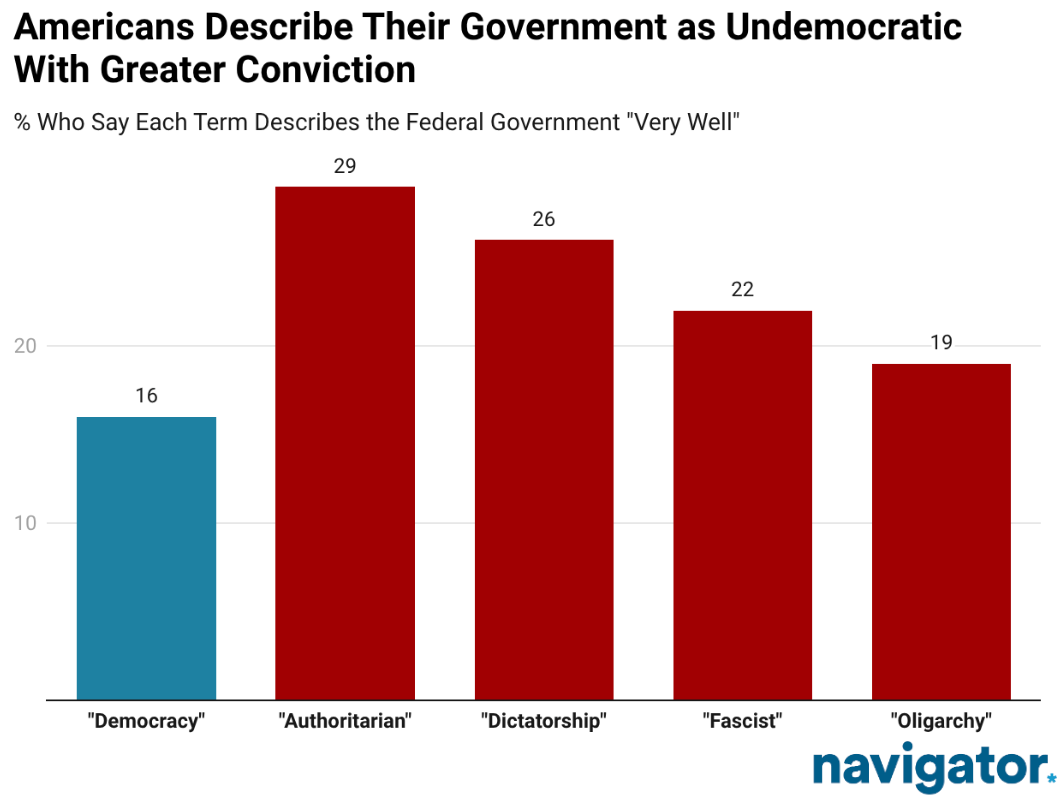
In a recent poll, 52% of Americans see the current government as “authoritarian,” with 47% describing it as a “dictatorship.” Of those who evaluate the terms “democracy,” “authoritarian,” “dictatorship,” “fascist,” and “oligarchy,” only 16% say the term “democracy” describes the federal government “very well.” The other terms illustrate the conviction with which Americans believe their government has changed:
A survey called Bright Line Watch has U.S. professors of political science rate the performance of American democracy, and the most recent one “finds that the vast majority think the United States is moving swiftly from liberal democracy toward some form of authoritarianism.”
However, many argue that the results of these surveys and polls are tainted by left-wing bias and the overwhelmingly left-leaning nature of scholars and others who are sounding the alarm simply because they don’t like the president or his policies. Indeed, another poll shows that “41% of Americans think ‘having a strong leader who does not have to bother with parliament or elections’ is a very good or fairly good system.” They are quick to point out that Trump was democratically elected, and that fact alone gives his government all the authority it needs to carry out the agenda on which he successfully ran for office.
Ironically, that poll supports the point being made by the others. Nevertheless, both the American left and right trade accusations about whose governance poses the greatest threat to American freedom, and their objectivity is legitimately questionable.
That’s why a research institute like the V-Dem (Varieties of Democracy) Institute at the University of Gothenburg in Sweden is valuable. According to their website:
V-Dem provides a multidimensional and disaggregated dataset that reflects the complexity of the concept of democracy as a system of rule that goes beyond the simple presence of elections. We distinguish between five high-level principles of democracy: electoral, liberal, participatory, deliberative, and egalitarian, and collect data to measure these principles.
In short, “the simple presence of elections” is not the only indicator of true democracy. Russia has elections that almost no one believes are credible, and history tells us that following democratic electoral processes is not a bulwark against authoritarianism, as Hitler used the process to have himself appointed Chancellor, after which he dismantled the Weimar Republic and established a dictatorship. He made no secret of his intentions, either:
“We must hold our noses and enter the Reichstag (Parliament),” he told followers, “to procure for ourselves the weapons of democracy. We’ll play their game, get the power legally, and then wreck it!”
The V-Dem Institute’s annual report, along with its dataset and graphing tools, was recently made available to the public, and the results were telling: “Nearly a quarter of the world’s nations are going through democratic backsliding, or autocratization,” with the U.S. notably among them:
The U.S. democracy is currently in a much faster deterioration process than any other democracy in modern times. Within only one year, the USA’s score on the V-Dem Liberal Democracy index has declined by 24 percent, while its world rank dropped from 20th to 51st place out of 179 nations.
The press release cites the current administration “undercutting institutionalized checks and balances, politicizing civil service and oversight bodies, and intimidating the judiciary, alongside attacks on the press, academia, civil liberties, and dissenting voices” as reasons for America’s precipitous fall on the index.
Stefan Lindberg, who founded the V-Dem Institute in 2012 and grew it to become “the world’s leading source for analysis of the health of global democracy,” according to The Guardian, said the U.S. has essentially erased all the gains of the past 61 years, falling back to 1965 levels, the era when civil rights legislation was being enacted to end racial authoritarianism in America. He also noted the speed with which this backsliding has happened:
For Orbán in Hungary, it took about four years, for Vučić in Serbia, it took eight years, and for Erdoğan in Turkey and Modi in India, it took about 10 years to accomplish the suppression of democratic institutions that Trump has achieved in only one year.
The White House, of course, dismissed the report with its usual contempt for anyone who questions or criticizes it, but the institute is dedicated to reporting that is “100% scientific, research-driven,” and backed by 32 million data elements in what they say is “the largest global dataset on democracy,” dating back to 1789, “free from bias and state influence, from general punditry and political considerations.”
As if to add an exclamation point to the V-Dem findings, Freedom House, a U.S.-based democracy tracking firm, in their “Freedom in the World 2026” reports:
In the United States, an escalation in both legislative dysfunction and executive dominance, growing pressure on people’s ability to engage in free expression, and the new administration’s moves to undermine anticorruption safeguards all contributed to the negative score change. The United States lost 3 points on the report’s 100-point scale, bringing its net decline since 2005 to 12 points, more than any other country rated Free during the same period except for Nauru and Bulgaria.
It would seem that the preponderance of the evidence, both internally and externally, points in a particular direction. Abraham Lincoln famously said:
At what point then is the approach of danger to be expected? I answer, if it ever reach us, it must spring up amongst us. It cannot come from abroad. If destruction be our lot, we must ourselves be its author and finisher. As a nation of freemen, we must live through all time, or die by suicide.
Thus, we have come to this point, understanding that we live in a time of polarization and the threat of authoritarianism, unlike anything we have seen in recent decades. What are we to do with this understanding? How are we to know what to do?
This much I know: there were millions of people just like you and me living in the Weimar Republic of Germany who either didn’t understand the times or did and failed to respond to them.
Some of them were possibly overwhelmed by the sheer pace of their nation’s race to fascism, barely able to react to one atrocity before another came along.
Others may have tuned things out because of their mental health, finding it easier to take refuge in family, friends, community, anything other than what was happening in the world around them.
Some of them cheered what was happening because their pride was wounded and their position in society diminished in the wake of war and economic and cultural instability; they longed for Germany to return to its former glory.
Some didn’t take the threat seriously, mocking the Nazis and the “vulgar little corporal” who led them, and considered them a fringe element that would soon pass.
Some may have had burdens in their personal lives that consumed them, rendering them unable to respond to events beyond the trials they were experiencing.
But history rhymes, and I realize in the late autumn of my life that what has happened in the past, even in another part of the world, can happen here, to us, today.
Yes, my head spins at how rapidly we are descending, and it’s a challenge to keep up with the abuses of power, lies, corruption, and hatred emanating from Washington daily, if not by the hour.
Yes, I sometimes worry that taking in what’s happening could lead me to despair; as someone who has ADHD, endured clinical depression, and who my family thinks has a tendency toward anxiety, I have to be mindful of my mental health.
Yes, I once mocked Trump and his followers, and didn’t think they would survive because common sense and decency would eventually prevail.
Yes, my ability to respond to the times is made much more difficult as I navigate through a rare, chronic, and incurable autoimmune disorder that came unexpectedly at a moment when my overall health was the best it had been in years. At the same time, I am dealing with the loss of multiple immediate family members and a beloved pet, most of those losses coming in the past two years, and the compounded grief has made me emotionally numb and unsteady.
Nevertheless, history rhymes, and at the end of the day, I want my children and grandchildren to know that I understood the times in which we lived, prayed to the Lord for wisdom, and did what I could to share what I learned with others. Even if no one outside of my family reads the words I write, I want there to be a record that I tried to speak the truth and stand for the powerless against the powerful.
Learn to do right; seek justice.
Defend the oppressed.
Take up the cause of the fatherless;
plead the case of the widow. (Isaiah 1:17)